# Maintenance

## Recommended Maintenance Schedule for IF1200

These recommendations are based on flight with a typical payload in optimal flight conditions. Additional maintenance may be needed at the pilot's discretion.

<table data-header-hidden><thead><tr><th width="332.77783203125"></th><th width="144"></th><th></th><th></th><th></th></tr></thead><tbody><tr><td><strong>Recommended Maintenance Activities</strong></td><td><strong>Pre-flight</strong></td><td><strong>25 Flight Hours</strong></td><td><strong>50 Flight Hours</strong></td><td><strong>3 Months</strong></td></tr><tr><td>Inspect all moving components for wear/damage</td><td>X</td><td></td><td><br></td><td></td></tr><tr><td>Check propellers for damage</td><td>X</td><td></td><td><br></td><td></td></tr><tr><td>Dust all lenses</td><td>X</td><td></td><td><br></td><td></td></tr><tr><td>Check Battery Health</td><td>X</td><td></td><td></td><td></td></tr><tr><td>Inspect all visible screws and tighten if needed according to torque guidelines (contact customer support)</td><td></td><td>X</td><td></td><td></td></tr><tr><td>Clean motors with an air can</td><td><br></td><td>X</td><td><br></td><td></td></tr><tr><td>Enable Battery Storage Mode (if not in use)</td><td></td><td></td><td></td><td>X</td></tr></tbody></table>

## Check Motors

Over time, motor bearings are exposed to wear and damage.&#x20;

### **To inspect motor bearings for anomalies:**

<table><thead><tr><th width="115" align="center">STEP</th><th>ACTION</th><th>RESPONSE</th></tr></thead><tbody><tr><td align="center">1</td><td>Give each motor a spin by hand</td><td>They should all coast to a stop and make the same sound</td></tr><tr><td align="center">2</td><td>Firmly grab each motor by the propeller hub or rotating portion of the motor and wiggle side to side </td><td>There should be zero or minimal play and all should feel similar</td></tr></tbody></table>

## Propeller Replacements&#x20;

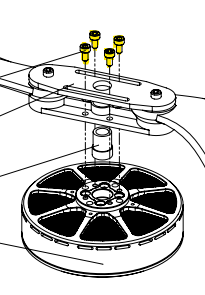
*The screws can be removed and installed using an **2.5mm hex driver**.* &#x20;

| Removing Props                                                                      | Installing Props                                                                                                                                                                                                                                                               |
| ----------------------------------------------------------------------------------- | ------------------------------------------------------------------------------------------------------------------------------------------------------------------------------------------------------------------------------------------------------------------------------ |
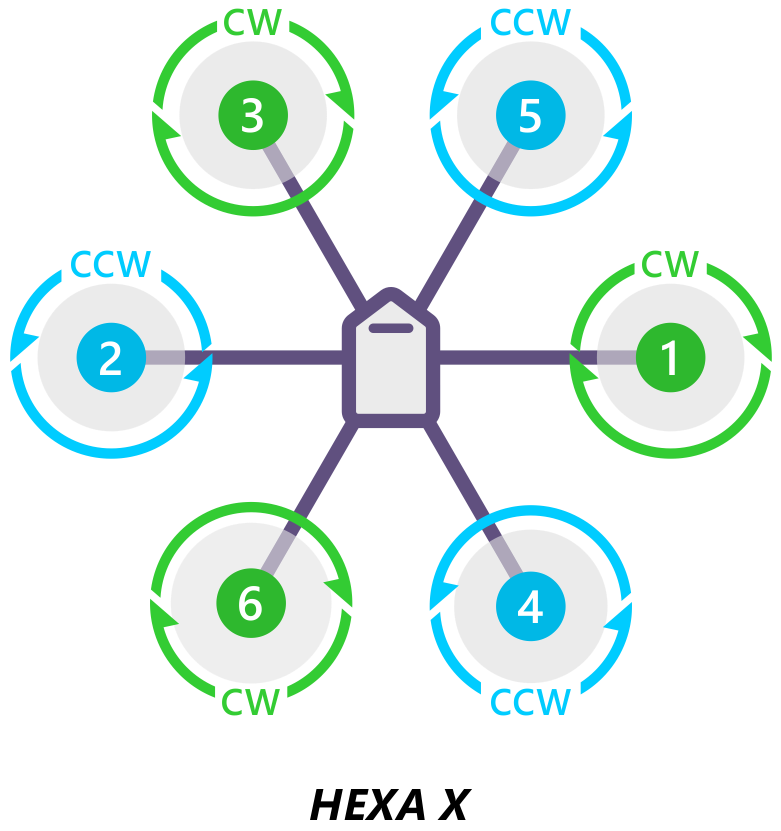
| The propellers are attached to the motor with 4 mounting screws and a locating pin. | <ul><li>Propellors marked 26.2 x 8.5R are mounted in position 2, 4, and 5. (See diagram below).</li><li>Propellors marked 26.2 x 8.5L are mounted in position 1, 3, and 6. (See diagram below).</li><li>Use Loctite Blue 242 on screws</li><li>Torque screws to 1.2N</li></ul> |

<figure><img src="https://240141666-files.gitbook.io/~/files/v0/b/gitbook-x-prod.appspot.com/o/spaces%2FhMePZ0UIa6VYv9VbYu4u%2Fuploads%2FobDhLa5NTzIkP10nlLV1%2Fimage.png?alt=media&#x26;token=dc85796b-8de7-4680-85e3-4be4d659c24e" alt=""><figcaption><p>Propeller Installation</p></figcaption></figure>

<figure><img src="https://240141666-files.gitbook.io/~/files/v0/b/gitbook-x-prod.appspot.com/o/spaces%2FhMePZ0UIa6VYv9VbYu4u%2Fuploads%2Fxs9Pxi96FORaV9uuRTOo%2Fimage.png?alt=media&#x26;token=15cd6769-fbe3-4649-aeef-6a7db5dc5c14" alt="" width="375"><figcaption><p>Standard HEXA X propellor positioning for hexcopters.</p></figcaption></figure>

## Every 3 Months: Check Battery Cell Voltage

* We recommend checking your battery's individual cell voltage before and after usage.
* While storing your battery for an extended period of time, check the voltage of each individual cell **at least once every three months** using either a LiPo checker or charger.
* When storing your battery, ensure each cell is **between 3.85V to 3.90V**.
* If the cell(s) **fall below 3.7V** or have more than 0.05V/50mV(6S), 0.1V/100mV(12S) difference, please **complete a charge/discharge cycle:** At 1C of lower rate, charge the battery to 4.2V/cell, then discharge down to 3.55V/Cell, and finally back to 3.85-3.9V/cell for storage.&#x20;

{% hint style="info" %}
NOTE: Batteries, especially those with a BMS board, will naturally self-discharge over time.  Adhere to the following tips to prolong the life of your battery:
{% endhint %}

<table data-header-hidden><thead><tr><th width="124" align="center">Steps to Prolong Battery Life</th><th></th></tr></thead><tbody><tr><td align="center">1</td><td>Always check your battery's individual cell voltage before and after usage.</td></tr><tr><td align="center">2</td><td>While storing your battery for an extended period of time, check the voltage of each individual cell <mark style="color:red;"><strong>at least once every three months</strong></mark> using either a LiPo checker or charger.</td></tr><tr><td align="center">3</td><td>When storing your battery, ensure each cell is <mark style="color:red;"><strong>between 3.85V to 3.90V</strong></mark>.</td></tr><tr><td align="center">4</td><td>If the cell(s) <mark style="color:red;"><strong>fall below 3.7V</strong></mark> or <mark style="color:red;"><strong>have more than 0.05V/50mV(6S)</strong></mark>, <em>0.1V/100mV(12S) difference, p</em>lease <mark style="color:red;"><strong>complete a Charge/Discharge Cycle:</strong></mark> At 1C <em>a lower rate</em>, charge the battery to 4.2V/cell, then discharge down to 3.55/Cell, and finally back to 3.85-3.9V/cell for storage. </td></tr></tbody></table>